The term femdom is short for female domination. It refers to a power-exchange dynamic in which a woman takes the leading role in intimacy or within a relationship, while her partner (whether male or female) voluntarily submits to her authority.
A woman who practices femdom is commonly called a domina, Mistress, or Maitresse.
Many myths and misconceptions surround female dominance because it is often misunderstood. For those who are well informed, femdom is a way to safely surrender control to a partner and deepen trust within a relationship. For those with distorted ideas about femdom, however, it can become a source of insecurity, shame, and unnecessary prejudice.

How Femdom Works in Practice
Femdom can take many different forms.
Many people imagine a domina as a woman dressed in tight latex, shouting orders while wielding a whip. While this image isn’t entirely inaccurate, femdom is far more diverse than that. It can encompass almost any BDSM practice, depending entirely on the preferences, boundaries, and agreements of the people involved.
There are countless femdom scenarios, and they don’t have to resemble the stereotypes commonly seen in pornography or discussed online. Physical extremes are by no means a requirement.
In practice, femdom might simply involve a woman taking charge during foreplay or sex. In this case, it’s a temporary exchange of power designed to add excitement to the couple’s sex life, after which the agreed-upon dynamic ends.
For some couples, however, the woman assumes the leadership role in everyday life as well. Here, female dominance extends beyond the bedroom. She may take responsibility for organizing the household, including managing finances.
In some relationships, this may even develop into financial domination (findom), where the submissive partner voluntarily entrusts the dominant woman with control over part of their money or financial decisions.
The submissive partner fully trusts their partner’s leadership and enjoys surrendering control. They may happily clean the house, do the shopping, attend school meetings, or handle official errands for the benefit of their Mistress.
Some couples also practice femdom on a 24/7 basis, but only in the realm of intimacy. In these relationships, the focus is typically on sexual control. The man may wear a chastity device as a symbol of his complete devotion.
Outside of their intimate dynamic, however, they remain equal partners who make everyday family and financial decisions together. They discuss issues openly and occasionally argue – just like any other couple.
Is Femdom Safe and Healthy for a Relationship?
Anything that both partners freely agree to is acceptable within a relationship.
You may be wondering whether femdom is “normal.” In both the bedroom and a relationship, anything that both partners willingly consent to and enjoy is considered normal.
Research on BDSM indicates that dominance and submission – whether as role-play or as a long-term preference – are widespread in society. International studies have consistently shown that millions of people around the world have experience with BDSM fantasies or practices.
When practiced correctly, femdom is not an abuse of authority or a form of one-sided control. As long as both partners agree on the structure and rules of their dynamic, it is a consensual and safe practice.
The submissive partner fully agrees to the dominant role of their female partner, and both enjoy the agreed-upon power exchange. This mutual consent helps maintain trust and prevents psychological or physical harm.
How to Begin Practicing Femdom as a Couple
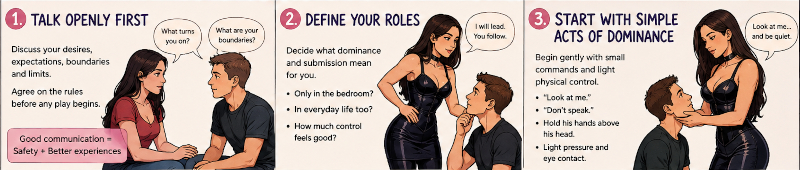
Before anything else, ask yourself why you are interested in femdom and where your personal boundaries lie.
Questions for the Man
A man should first reflect on questions such as:
How do I want to feel in a femdom relationship?
Do I want to feel adored, loved, and cared for?
Do I want to surrender completely to my partner while remaining equals outside of that dynamic?
Do I want my partner to control me? Only in the bedroom, or in everyday life as well?
Would I enjoy being ignored occasionally by my Mistress?
Am I interested in verbal or physical humiliation?
Should physical punishment be part of our play? If so, what kind?
Do I want to serve my partner purely for her pleasure, regardless of my own orgasm?
Do I want to earn permission to ejaculate as a reward?
Or would I rather orgasm during every sexual encounter?
What interests me but still feels too embarrassing to talk about?
Which forms of dominance excite me, and which make me uncomfortable?
Questions for the Woman
The woman should ask herself similar questions:
Do I genuinely want to take the leading role?
Which BDSM practices am I comfortable exploring, and where are my limits?
Do I want to dominate only during sexual play, or in daily life as well?
Am I naturally strict and directive, or do I prefer a nurturing style of dominance?
Does my partner’s submissive side excite me, or does it make me uncomfortable?
How often do I want to be in the dominant role?
Am I doing this because I want it, or simply to please my partner?
What would our ideal femdom dynamic look like in the long term?
Am I prepared to communicate openly about rules, boundaries, and safety?

Discuss these questions together to determine whether femdom is right for you and what experiences you hope to share.
It is important that both partners understand: what excites them, how they envision their dominant or submissive roles, and what boundaries they want to establish. Only then can you begin building a femdom relationship that suits both of you.
Start Slowly
For example, begin with simple commands such as: “Look at me and don’t say anything.” Or, during sex, the dominant partner might gently hold the submissive partner’s hands above their head, applying only slight pressure while maintaining eye contact and observing their reactions. Or, during sex, the dominant partner might gently hold the submissive partner’s hands above their head, applying only slight pressure while maintaining eye contact and observing their reactions.
Some men fantasize about female dominance for years but discover that reality differs significantly from fantasy. What seemed exciting in imagination or pornography may not feel enjoyable in real life. That is perfectly normal. If certain activities don’t feel right, discuss them openly with your partner. Modify the scenario or stop that activity altogether.
What Types of Femdom Are There?
Femdom can encompass almost every type of BDSM practice and is generally divided into soft (light) femdom and advanced (hard) femdom. This naturally raises the question of whether femdom is painful. There is no simple answer—it can be, but it doesn’t have to be. Everything depends on the type of play and the level of intensity both partners desire.
Soft Femdom
Soft femdom includes less intense forms of dominance that are ideal for adding variety to a couple’s intimate life, especially for beginners. It is also popular among couples who enjoy occasional power exchange without making dominance a central part of their lifestyle.
Examples include:
- Light erotic role-play, such as teacher and student or policewoman and prisoner.
- Verbal dominance and female-led intimacy, including gentle humiliation, giving commands, setting the pace during sex, granting permission to become aroused, and similar dynamics.
- Light bondage using satin ribbons or simply holding a partner’s hands above their head.
- Wearing latex or leather outfits and high heels to enhance the dominant role.
- Feminization or dressing a man in feminine clothing.
- Foot fetish play and foot worship.
Gentle Femdom
Few people realize that femdom can also be incredibly tender. Gentle femdom focuses on loving female leadership without pain or humiliation. Many people have probably experienced some form of it without even realizing it.
The woman remains the dominant partner, while her partner willingly surrenders to her affectionate and caring guidance. The emphasis is not on pain but on sensual touch and intimacy that lead to pleasure and orgasm. The woman enjoys taking the lead and decides which techniques, toys, or forms of stimulation she will use to satisfy her partner.
Advanced Femdom
More advanced femdom practices may include:
- Role reversal or pegging, in which a woman anally penetrates her partner using a strap-on harness. This is often regarded as one of the most intense expressions of female dominance.
- More intense BDSM activities such as advanced bondage, spanking, CBT (Cock and Ball Torture), or sounding (urethral dilation).
- Long-term role-play scenarios and the use of chastity devices as tools of control and power.
Aftercare Is an Essential Part of Femdom
Why Aftercare Matters
Once a scene has ended, don’t overlook aftercare – the care and emotional support that follow BDSM play. Take time to relax together, talk about what you enjoyed and what you didn’t, and reassure one another with affection. If you’ve engaged in more physically demanding BDSM activities, treat any marks or sore areas with a soothing cream.
Every couple approaches aftercare differently. Some enjoy cuddling before taking a shower together. Others prepare dinner, spend a quiet evening together, or simply lie in each other’s arms in silence.The most important goal is to help both partners calm their minds and bodies while making sure they both feel safe and emotionally secure.
Dominance and submission often trigger powerful emotional and physiological responses because the body releases adrenaline and endorphins. Once a scene is over, fatigue and emotional vulnerability are common. Proper aftercare helps restore emotional balance while strengthening trust, intimacy, and a sense of safety between partners.
Setting Boundaries and Staying Safe
Respect the Rules You Agree On
As mentioned earlier, all sexual activities – including femdom – are built on mutual consent, trust, and clearly defined boundaries.
Discuss your expectations beforehand or even write them down as a symbolic agreement. Record not only your fantasies and desires but also the activities or situations that make either of you uncomfortable. The more detailed your agreement or scene plan is, the more confident and relaxed both partners are likely to feel.
The submissive partner also holds an important form of power within a femdom relationship. By using a pre-agreed safe word, they can stop a scene at any time. Common safe words include “red” or simply “stop.”
Many couples prefer a traffic light system:
- Green – Everything is going well and the scene can continue.
- Orange – The submissive partner is approaching their limit and wants the dominant partner to ease the intensity, whether physically or verbally.
- Red – Stop immediately. The scene ends at once.
A dominant woman should always respect her partner’s limits and never cross or push beyond previously agreed boundaries without explicit consent. What is never acceptable is coercion, manipulation, or abusing a position of authority.
Remember that every couple defines their own comfort zone differently. What seems like a mild practice to one couple may feel too intense for another. Even an activity commonly considered “soft” can be beyond someone’s personal limits.
Always listen to your instincts and take your feelings seriously. If something doesn’t feel right, postpone it or discuss it with your partner before trying again.
You may also discover that a dominance-based relationship simply isn’t right for you. That’s perfectly okay – femdom isn’t for everyone. An essential part of healthy boundaries is understanding that either partner may withdraw consent at any time, and that decision should always be respected, even if it’s disappointing.